
Criminal Court Cases in Brown County
Two courts divide the local criminal docket. Brown County Court handles misdemeanors, traffic offenses, and preliminary felony work. A felony complaint may first appear there for an initial hearing before the prosecution moves to Brown District Court, the general-jurisdiction felony trial court in Judicial District 8. Both Brown County counters are at 148 W 4th Street in Ainsworth. County Court is open from 8:00 a.m. to 4:30 p.m. weekdays and can be reached at 402-387-2864. Clerk of District Court Travis Hobbs can be reached at 402-387-2705. Each clerk keeps filings, orders, the register of actions, disposition, and sentence. Searching only one court type can leave out a key part of the procedural trail.
The official County Court listing shows the local court counter and its access details.
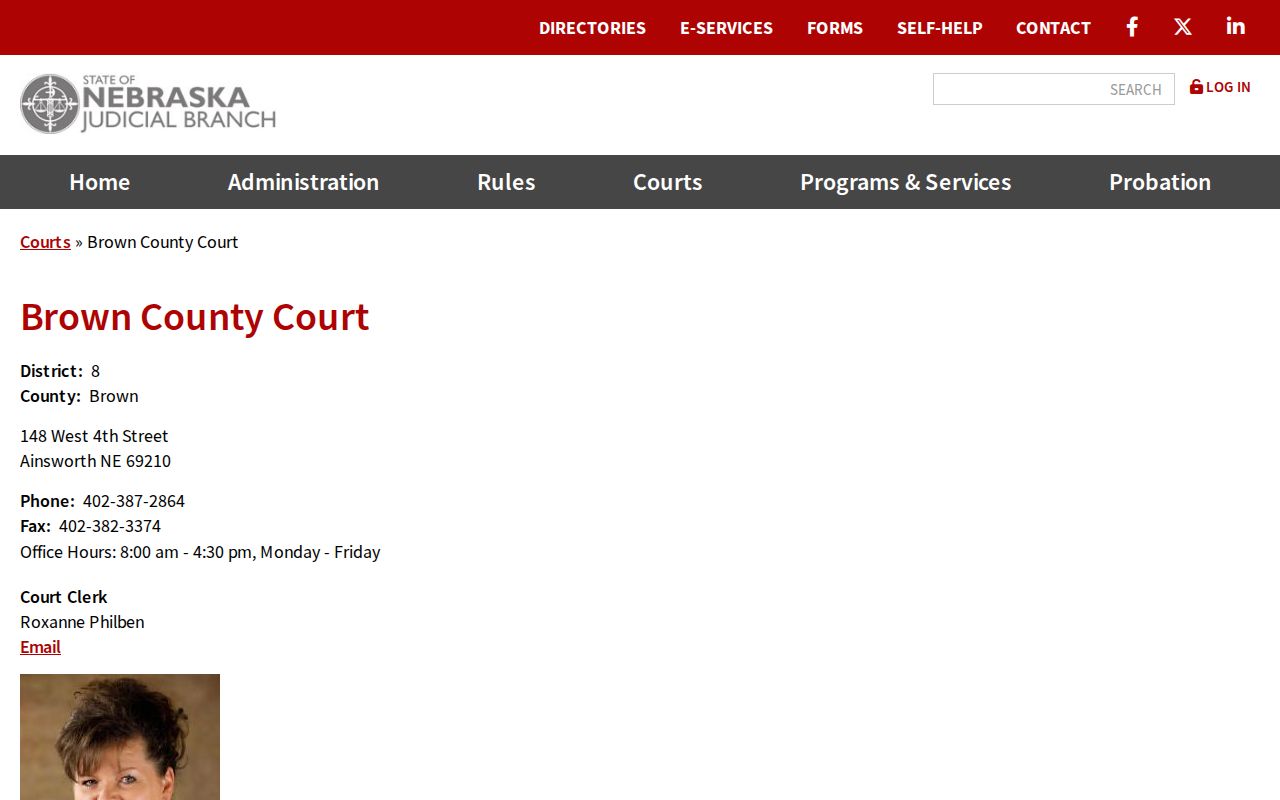
That local listing is the best place to confirm hours before a trip across Brown County.
Search Both Brown County Courts
A party-name search must be run against both court types when the charge level or path is unclear. A misdemeanor normally remains in County Court. A felony allegation can create entries there before the District Court file becomes the main trial record. Brown County has no separate municipal court portal or local docket database, so statewide JUSTICE carries the public online search load. Courthouse staff may locate a specifically identified case when given a complete name, year, case type, or case number. They do not issue a certificate stating that a broad search found no record. Matching the party, year, offense, and dates across both court types prevents a missed record or false duplicate.
The Judicial Branch District Court page identifies the felony court serving Brown County.
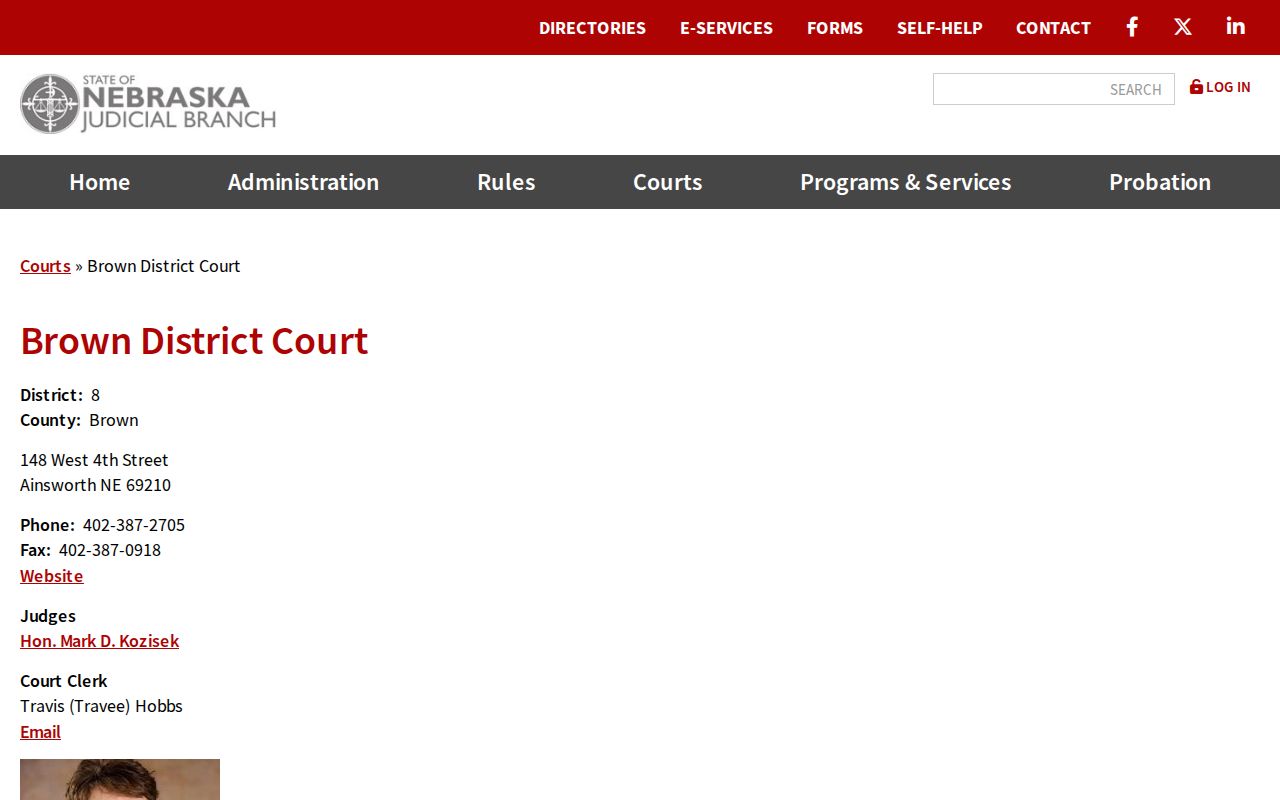
It provides an official cross-check when similar county names or stale directory pages appear in search results.
Brown County Case Record Searches
JUSTICE One-Time Search costs $17, searches statewide trial-court data, and returns no more than 30 cases. Its index is about 24 hours behind court entry and does not include document images. Subscriber access costs $100 per year, supports broader fields, and currently charges $2 to open case details. Many available filed-document images then carry no separate image fee. A free courthouse public-access terminal is the sound first choice for a local, focused Brown County search.
- Start at the courthouse terminal or open JUSTICE and enter the party's full name.
- Search Brown County Court, then repeat the search for Brown District Court.
- Use the county, filing year, case type, or exact case number to narrow likely matches.
- Open the case and read every count plus the chronological register of actions.
- Ask the correct clerk to inspect, copy, or certify the identified filing or order.
The available fields differ between the one-time and subscriber products. Former names should be searched separately because a name change may divide results.
| Field Label | Type | Required | Notes |
|---|---|---|---|
| First name | Text | Portal rule | Party-name search field |
| Last name | Text | Portal rule | Use the full current name |
| Court type | Selector | As offered | Repeat for County and District Court |
| County | Dropdown | No | Select Brown for local results |
| Case type or year | Dropdown | No | Subscriber search can narrow the docket |
| Case number | Text | No | Best route to one known file |
Note: JUSTICE requires JavaScript, and the one-time result is an index rather than a full set of filed documents.
Compare Brown County Case Access
The access channel should match the task. Use the free terminal to inspect Brown County case data without an Internet search fee. Use the one-time product for a quick statewide name index from home. Subscriber service is aimed at repeat research with filters and file images. Contact the clerk when a certified copy, a paper-only filing, or help with an older record is needed. These channels do not promise the same output.
| Channel | Cost | Best Use | Key Limit |
|---|---|---|---|
| Courthouse terminal | Free | Local case inspection | Requires a courthouse visit |
| One-time JUSTICE | $17 | Remote name search | 30-case cap; no images |
| Subscriber JUSTICE | $100 yearly; $2 detail | Repeat and fielded searches | Account required |
| Court clerk | Confirm copy cost | Specific copies and certification | No negative-search certificate |
The Judicial Branch's case-information service page explains these access tiers.
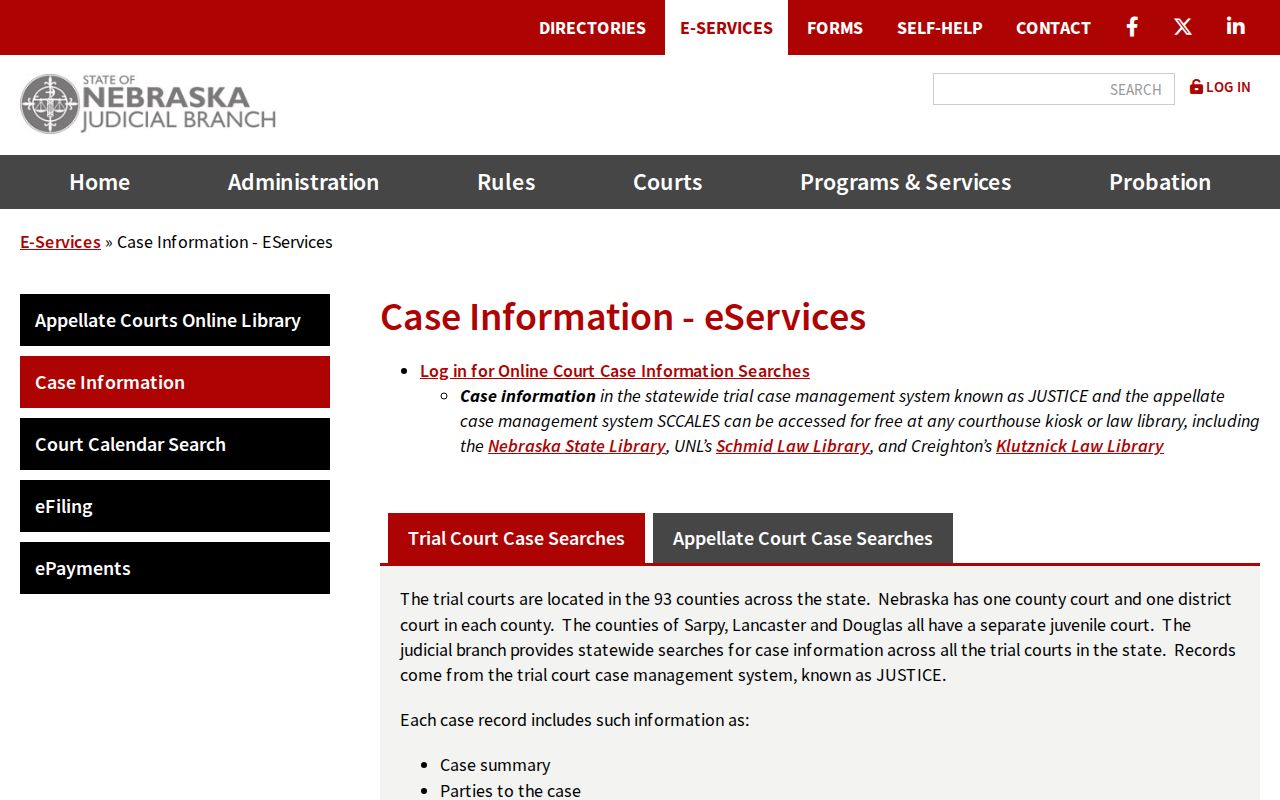
The service overview helps a Brown County searcher avoid paying for a product that lacks the needed document images.
What a Criminal Case File Contains
A Brown County criminal case file records what prosecutors filed and what the court did. It is not the sheriff's account of the event. The case summary points to the court, case number, filing date, status, assigned judge, and outcome. The offense panel separates counts. The register of actions arranges complaints, appearances, pleas, motions, hearings, orders, judgment, sentence, and any appeal event in date order.
| Case number and court | Identifies the precise Brown County proceeding and its trial-court level. |
|---|---|
| Charging document | Shows the complaint, information, or other filed allegation. |
| Offense information | Lists each count, description, classification, alleged date, and recorded result. |
| Register of actions | Provides the dated sequence of filings, hearings, orders, and rulings. |
| Financial entries | Shows assessed costs, judgments, and payments recorded by the court. |
| Disposition and sentence | States the outcome and punishment or conditions ordered by the judge. |
A dismissal on one count does not decide the others. Read the outcome field count by count, then check the final judgment and sentence. Subscriber images may provide the actual order, while the one-time search supplies no document images. For an arrest-stage view before charges were filed, use the separate Brown County arrest search.
Brown County Felony File Path
A felony matter can leave a trail in both trial courts. County Court performs preliminary felony functions. If the prosecution continues at the felony level, Brown District Court becomes the court of general jurisdiction for the trial file. Search dates, parties, and counts across both dockets before deciding that part of the history is absent. The County Attorney's filed charge may also differ from the arresting officer's initial allegation.
The Brown County District Court office page identifies the local clerk channel for felony files and copies.
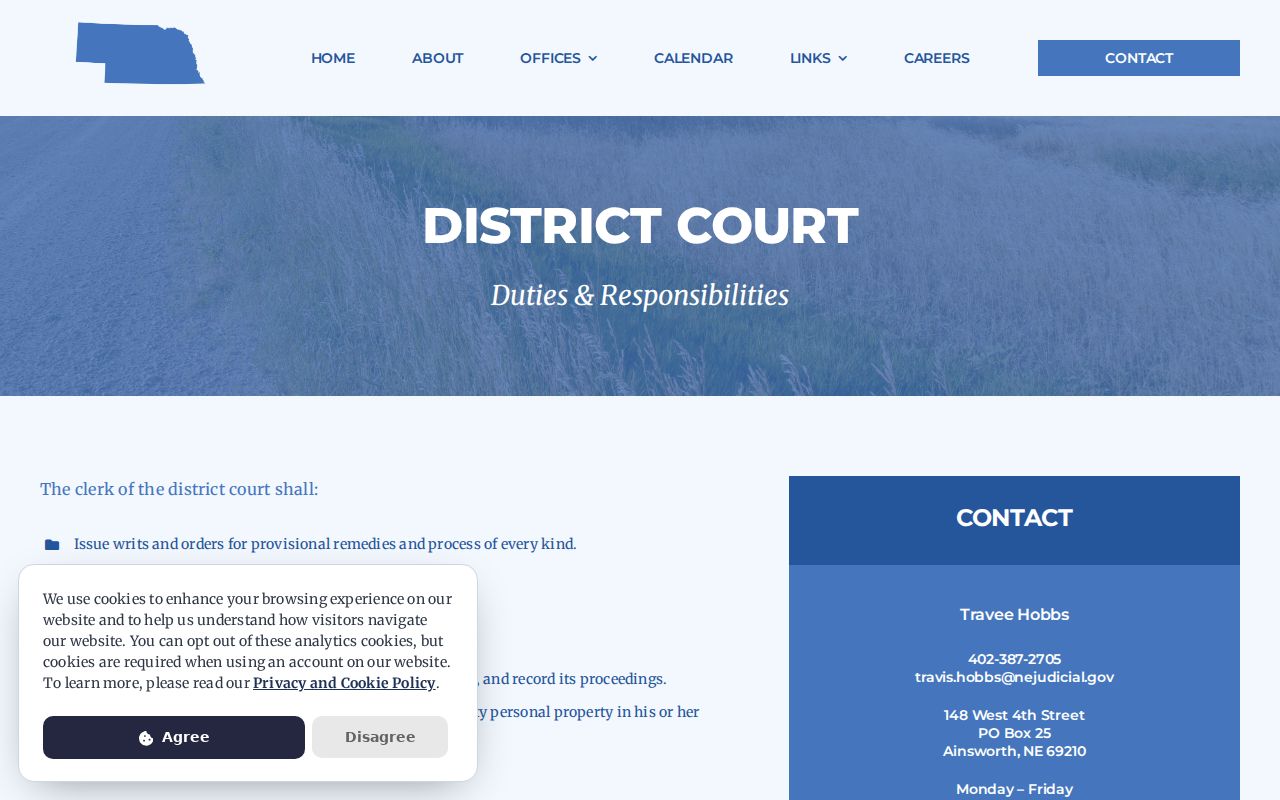
This county office source is especially useful when a remote result must be matched to a certified Brown District Court document.
The offense classification offers another clue. Nebraska Class I through IV felonies fall within District Court's felony jurisdiction, while County Court handles misdemeanors under the state's lower penalty structure. The class describes the statutory penalty range, not the result in one Brown County case. The filed count and final disposition still control.
Criminal Case Stages in Brown County
Criminal case stages appear as docket events, not as one fixed summary line. An arrest or citation precedes the court file. The prosecutor then decides what to file. Arraignment records the plea. Pretrial entries can include motions, scheduling orders, discovery disputes, and bond rulings. A plea or trial produces the adjudication, followed by disposition and sentencing. An appeal may add later events.
Case flow: Charges Filed › Arraignment › Pretrial › Plea or Trial › Disposition › Sentencing
Felony allegations may add a transfer from Brown County Court to Brown District Court. Timing varies by case, so the docket itself is the reliable chronology. An online lag of about 24 hours also means a new hearing or filing may not appear immediately. Call the clerk when a current deadline or courtroom status matters.
Reading Brown County Case Outcomes
Disposition means the recorded result of a charge or case. An acquittal is a not-guilty result after adjudication. A dismissal ends a filed count without a conviction on that count. “Nolle pros” is short for nolle prosequi, a prosecutor's choice not to continue a charge. A plea is the defendant's formal response, while judgment is the court's formal determination. These terms should not be treated as interchangeable.
- Register of actions
- The date-ordered list of filings, hearings, and court orders.
- Disposition
- The recorded outcome for a charge or case.
- Arraignment
- The hearing where charges are stated and a plea is entered.
- Set aside
- A Nebraska order that nullifies a qualifying conviction but leaves a historical record of the case and relief.
If a court outcome is wrong on an NSP RAP, start with the Brown County court of record. Obtain the correct disposition and ask the source to update its entry before requesting NSP correction. The repository cannot create a result the court has not supplied.
Older Brown County Court Files
Older or lawfully destroyed records require clerk help. Nebraska court policy refers to Records Retention and Disposition Schedule 18, and the clerk may provide a form letter when a file was destroyed under that schedule. A missing online hit does not establish destruction, sealing, or the absence of a case. It may reflect age, an alternate name, a different court type, or an indexing issue. Ask first to inspect the specific Brown County file. Then identify the exact complaint, order, judgment, or sentence needed and whether a plain or certified copy will serve the purpose. County Court copy and certification charges are governed by state law, but the total should be confirmed before payment.
Federal prosecutions are outside JUSTICE. The official PACER service carries federal court records, including matters filed in the U.S. District Court for the District of Nebraska.
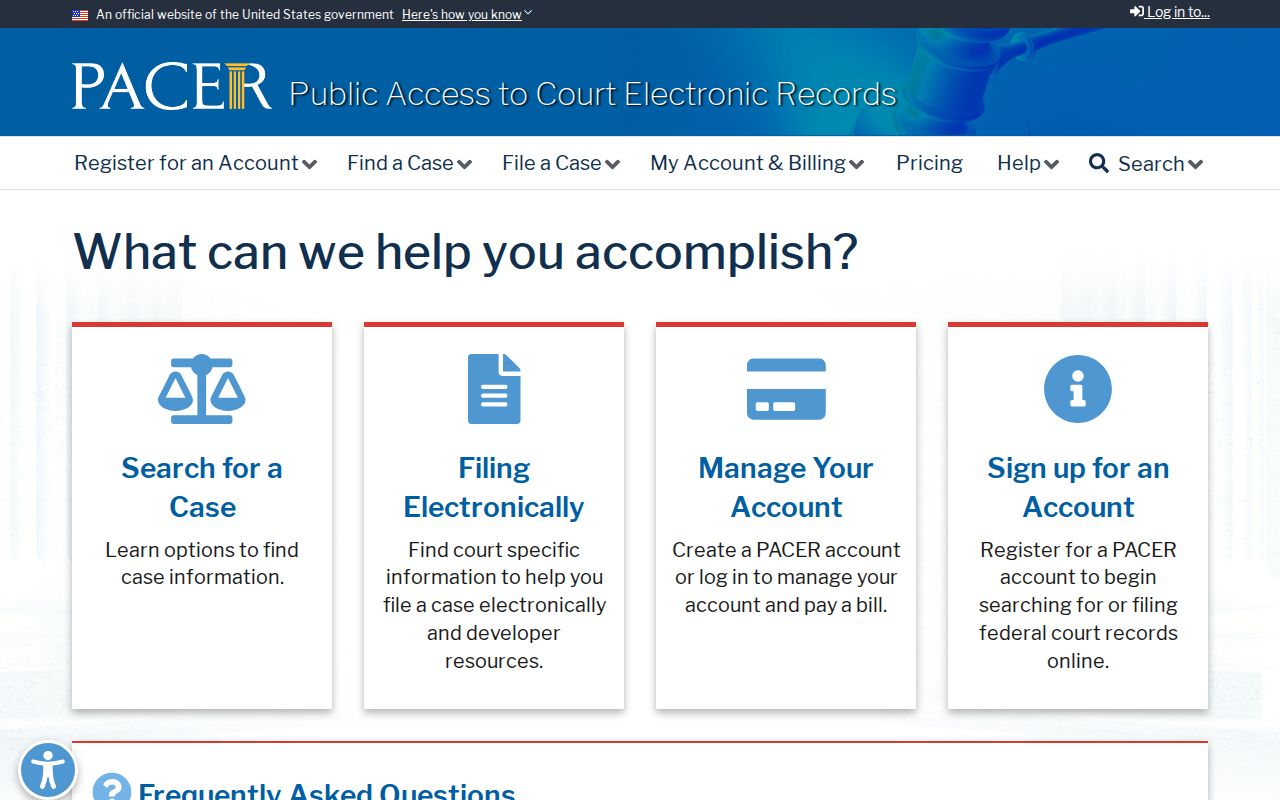
PACER is a separate federal channel, so its absence from Brown County JUSTICE results is expected.
Access Rules for Case Records
The Nebraska Public Records Act supports inspection and copying during office hours, subject to statutory exceptions. Nebraska court policy lets staff locate specifically identified cases and provides courthouse and formal request paths. It does not make every case or every field public. Sealed matters, confidential juvenile records, protected victim data, and other restricted content may be absent or redacted.
Online access can be narrower than the courthouse file. Ask the Brown County clerk about a case that does not appear, but provide enough facts to identify it. Staff will not issue a negative-search certificate. If a qualifying dismissed or acquitted case has been sealed, ordinary public search should not expose it. A set-aside has a different effect: the court history can show the conviction and the later relief.
Note: A blank name-search result is not proof that no Brown County proceeding ever existed.